Posted on

Why Every High School Student Should Study Biology, Chemistry, and Physics (Even If College Isn’t the Plan)

When planning a high school course of study, it’s tempting to tailor everything toward a student’s intended path. If your teenager is heading to a four-year university, you load up on lab sciences because admissions committees expect them. If your student is eyeing the trades, entrepreneurship, or direct entry into the workforce, you might wonder whether all three sciences are really necessary. Wouldn’t that time be better spent on something more “practical”?

It’s a reasonable question. But the answer, perhaps surprisingly, is that biology, chemistry, and physics belong in every high school student’s education regardless of what comes after graduation. The reasons go far beyond checking boxes for college applications.


The College-Bound Student: More Than Admissions Requirements

Yes, most four-year colleges expect to see biology, chemistry, and physics on a transcript. Competitive universities often want to see these courses taken at an honors or AP level. But framing science education purely as an admissions strategy misses the deeper point.

Students heading to college will encounter a world that increasingly demands scientific literacy. Even those majoring in history, literature, or business will face questions that require some grasp of how the natural world works. How should society weigh the risks and benefits of new medical technologies? What’s actually being claimed in that news article about climate, nutrition, or disease? Is this politician’s statement about energy policy grounded in reality?

A student who has genuinely grappled with the principles of biology, chemistry, and physics possesses something valuable: the ability to think critically about scientific claims rather than simply accepting or rejecting them based on tribal loyalties. This kind of literacy isn’t a luxury for future scientists alone. It’s part of being an informed citizen and a thoughtful person.

There’s also the matter of keeping doors open. Many students change direction during college (sometimes dramatically). The freshman who was certain about an English major discovers a passion for environmental science. The business student realizes she wants to pursue nursing. Students who skipped chemistry or physics in high school often find these pivots costly, requiring extra semesters of prerequisite courses. A solid foundation in all three sciences provides flexibility that students rarely appreciate until they need it.

The Non-College-Bound Student: Why Science Still Matters

Here’s where parents sometimes push back. “My son is going to be an electrician. Why does he need to study biology?” Or: “My daughter is starting a business right out of high school. How will chemistry help her?”

These questions deserve a thoughtful answer, not a dismissive one. And the answer has several layers.

First, there’s the practical dimension that’s often overlooked. Tradespeople encounter science constantly.

  • The electrician works with principles grounded in physics such as resistance, current, voltage, and the behavior of electromagnetic fields.
  • The welder needs to understand how different metals respond to heat, which is applied chemistry.
  • The auto mechanic troubleshoots systems that involve combustion, fluid dynamics, and electronics.
  • The HVAC technician deals daily with thermodynamics.

Even careers that seem far removed from the laboratory often rely on scientific principles, and workers who understand the “why” behind their procedures tend to be more skilled, safer, and better at solving novel problems than those who merely follow steps by rote.

Then there’s the matter of health literacy. Every person, regardless of career path, will make decisions about their own health and the health of family members. Understanding basic biology like how the immune system works, how medications interact with body systems, and how nutrition affects well-being, equips people to have informed conversations with doctors, evaluate health claims, and make wise choices. This isn’t about turning everyone into a medical professional. It’s about not being helpless when faced with important decisions.

Scientific study also cultivates habits of mind that transfer far beyond the laboratory. When students learn to form hypotheses, test them against evidence, and revise their thinking based on results, they’re developing critical thinking skills that apply everywhere.

The entrepreneur evaluating a business idea, the parent researching educational options, the voter assessing a candidate’s claims, all of them benefit from the disciplined thinking that science education develops.

Addressing the Student’s Perspective

Students themselves sometimes resist the full slate of sciences. A few responses to common objections might be helpful.

“I already know I want to work with my hands, not sit in a lab.” Working with your hands is more effective when your head understands what’s happening.

The carpenter who grasps why wood expands and contracts with humidity does better work. The farmer who understands soil chemistry grows better crops. Science isn’t opposed to practical work, it illuminates it.

“I’m not good at science.” Often this means “I struggled with the way science was previously taught” or “I haven’t yet found the right approach.” Science at its core is about curiosity and careful observation, qualities most students possess naturally.

A different curriculum, a more hands-on approach, or simply connecting concepts to real-world applications can transform a student’s experience. Struggling with a subject is also not a reason to avoid it entirely. Some of the most valuable learning happens at the edge of our comfort zones.

“I’ll never use this.” The same could be said of many things we study, yet education isn’t purely vocational training.

We study history not because we’ll all become historians but because understanding the past helps us navigate the present. We study literature not to become novelists but to develop empathy and insight into the human condition. Similarly, we study science not only for career preparation but because understanding the natural world is part of being a complete person.

The Integrated Vision

There’s a broader point here about what education is for. If we view high school merely as job training or college prep, we’ll naturally ask narrow questions about which courses pay off and which are expendable. But if we view education as formation, as the shaping of a whole person equipped to think well, live wisely, and engage meaningfully with the world, then the question shifts.

The natural world is staggeringly complex and elegant. Biology reveals the intricate systems that sustain life, from the molecular machinery inside every cell to the web of relationships in an ecosystem. Chemistry uncovers the principles governing how matter interacts, transforms, and combines. Physics describes the fundamental rules underlying everything from the motion of planets to the light that lets us see. To move through life without ever seriously engaging these disciplines is to miss out on entire dimensions of understanding.

This isn’t about forcing every student to love science or pursue it professionally. People have different gifts, interests, and callings. But there’s a difference between choosing to focus elsewhere after gaining a foundation and never acquiring that foundation at all. The first is informed specialization. The second is unnecessary limitation.

A Final Word to Homeschooling Parents

You know your student better than any curriculum guide or admissions counselor does. You understand their strengths, struggles, and aspirations in ways no one else can. The suggestion that all students benefit from biology, chemistry, and physics isn’t meant to override that knowledge. It’s meant to inform it.

Even when a course feels like a stretch for a particular student, even when the career path they’re eyeing doesn’t seem to require it, there’s value in working through challenging material that expands their understanding of the world.

The goal isn’t to produce scientists. It’s to produce capable, thoughtful adults who can navigate a world where science touches nearly everything from the medical decisions they’ll face, to the technologies they’ll use, to the public debates they’ll engage in as citizens.

That’s a goal worth pursuing, whether your student is heading to a university, a trade school, a family business, or a path they’ll carve out for themselves. And you can absolutely teach the sciences at home.

Posted on

Berean Builders: College Science Prep For Homeschoolers

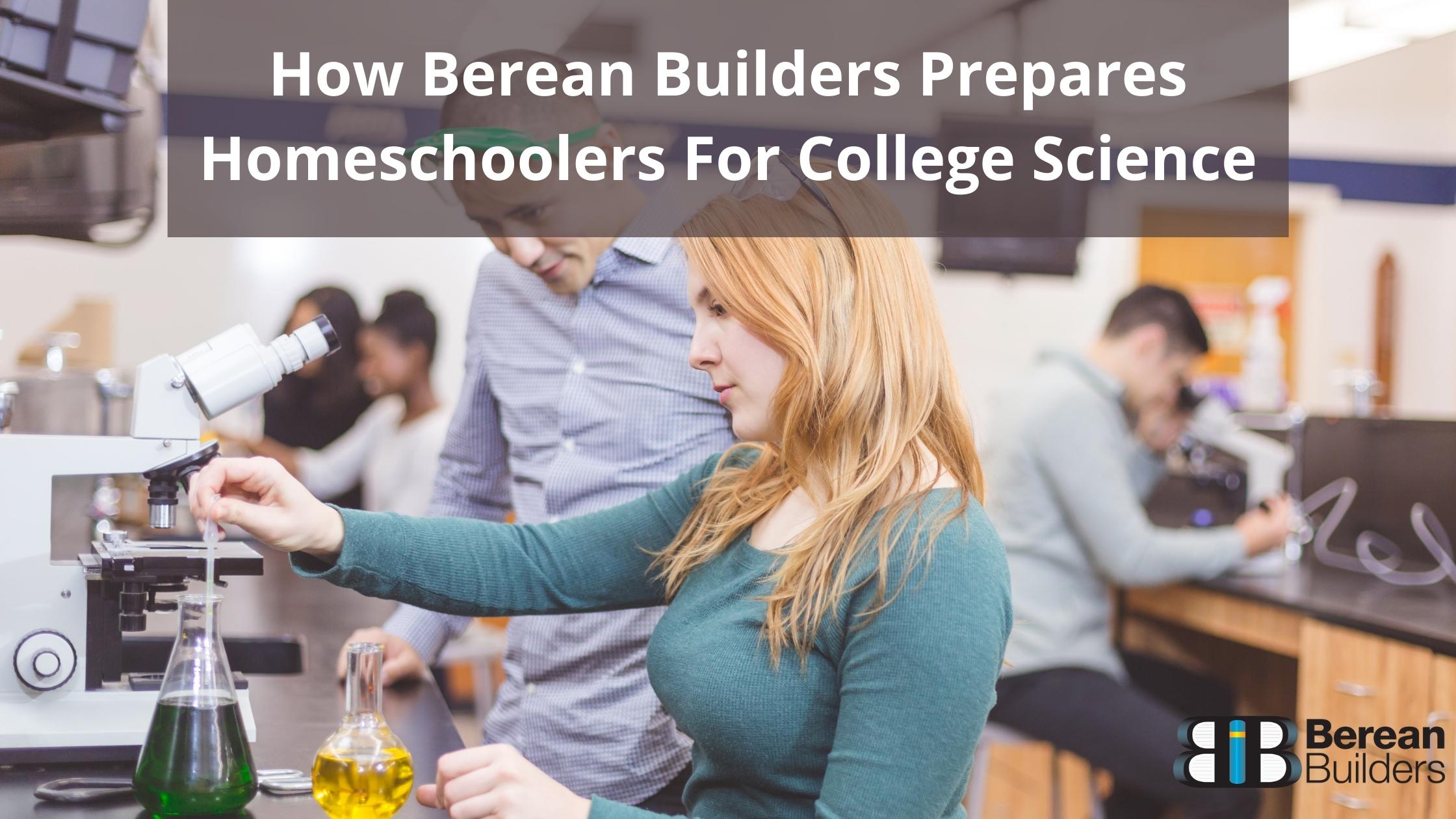
homeschool students in college science lab

When your homeschool graduate gets to college, will they be ready for science?

How can you be sure?

Most of us remember science classes and labs in school. The smells, the jars and bottles of strange and wonderful substances and all those instruments! Plus mounds of new and exciting information.

Our teachers guided us through the systems and methods of high school science and lab work, and some of us took that to college where we realized…

We didn’t really know all that much about post-secondary science OR labs.

Our professors had to toss in some remedial instruction so we could succeed without blowing up the chemistry lab or cross-contaminating our petri dishes in the biology lab.

Not to mention the basic stuff we should have brought with us from high school.

And honestly, the last thing a college professor wants to do is fill in the blanks left by a high school teacher, no matter how talented that teacher was.

If you remember those days, or if you are concerned that you can’t possibly prepare your homeschooler for science in college, we’re here for you.

One of the most common homeschool parent worries is how to be sure their student is ready for college. And it’s a legitimate worry.

However, if you are presenting science courses from Berean Builders at home, your homeschooler is already getting college-prep science training.

College Prep Science For Homechoolers

First of all, Dr. Wile is a university professor.

He already knows the skills your student needs to be successful in college-level science.

Not only can Dr. Wile pass on this knowledge through the detailed material and extensive labs included in each Berean Builders science course, but he also helps students hone their critical thinking skills.

Critical thinking is vital, not only in science but in other subjects, as well as life after college.

Secondly, high school science is intended to give students a solid knowledge base on which they can build once they reach college.

This knowledge base is imperative.

In Dr. Wile’s words,

“You can’t stop to Google every time you have a problem.”

Some facts and processes need to be readily available in the quick access section of a student’s memory.

Berean Builders science courses build that base.

Your homeschool graduate will have the body of knowledge in their head that a university professor expects them to know.

Science courses from Berean Builders prepare students for college

The method behind our science courses combines comprehension checks throughout each lesson with reviews and knowledge tests at the end.

The reviews and tests help your student understand the facts presented, and the comprehension checks train your student how to think like a scientist.

These checks and reviews are balanced to help your student gain the facts they need and the thinking skills to apply them.

Why does this matter?

In order for your student to get the most out of college-level science courses and their associated labs, they can’t have facts at the exclusion of thinking skills, and vice versa.

Rote memorization may result in good grades in high school, but facts without critical thinking skills won’t help them advance in higher learning.

Conversely, thinking skills without facts won’t help them much either. Remember the Google comment above?

With Berean Builders, you can be confident you’ve provided your homeschool student the same level of instruction they would receive from high school college prep courses…if not better.

After all, they’ll be getting their high school education from a university professor. Which means your homeschool students will already be learning science skills at a college prep level.

University Professor On Standby For Your High Schooler

Not only that, Dr. Wile is easily accessible if your student has questions.

He’s only an email away, and he is eager to help his science students comprehend the concepts he presents in the courses.

Berean Builders brings science to your homeschool with professional labs designed to be conducted right at home.

To be sure your homeschool graduate has a well-rounded science education, include Berean Builders science courses in your planning for next year.

We’re here to help you determine the best sequence to present science subjects, and we’re looking forward to working with you as you help your student get ready for college and life beyond.